How to Create a Facebook Ad That Converts in 2026
A complete guide to creating high-performing Facebook ads in 2026. Covers the structure of a creative that converts, formats, visual hooks, copywriting and A/B testing to maximize your ROAS.
SociaLover Team · Updated · 14 min read
A Facebook ad that converts in 2026 follows six decisions in order: a Conversions objective with the Purchase event, lookalike or Advantage+ audiences, a scroll-stopping 9:16 or 4:5 visual, copy built as hook, benefit, proof, CTA, a three-level structure with 2 to 4 creatives per ad set, then scaling by 20 to 30% every 48 to 72 hours.
This guide walks through the six decisions in that order, with the 2026 Meta benchmarks to read your results against and the AI tools that shorten the creative step.
What you'll learn
Choose the right campaign objective
Choosing your objective is the most important decision in your entire campaign. Meta optimizes ad delivery based on the objective you set. Pick the wrong one and the algorithm optimizes for the wrong action. If you are not sure which objective fits your funnel, plan the campaign with Ads Strategist: it turns your product, audience and goal into an objective, a structure and a first set of angles.
Awareness
When: New product, new brand
KPI: Reach, impressions, frequency
Traffic
When: Drive site or app visits
KPI: CPC, CTR, landing page visits
Conversions
When: Purchase, lead, sign-up
KPI: CPA, ROAS, conversion rate
For an e-commerce store or an offer with a dedicated sales page, always start with the "Conversions" objective and the "Purchase" event, even if your budget is small.
Set up targeting: cold vs. warm audiences
The recommended audience structure for 2026:
Lookalike Audiences (1 to 3%)
Cold, top of funnelBuild lookalike audiences from your buyers, 30-day visitors, or email subscribers. This is the highest-performing targeting for accounts with history.
Interest-Based Targeting
Cold, no dataUse interests only for new accounts with no data. Stack 2 to 3 relevant interests and exclude existing buyers.
Retargeting (visitors, abandoned cart)
Warm, bottom of funnelRetarget visitors from the last 7 to 14 days and cart abandoners. Recommended budget: 20% of your total budget.
Custom Audiences (previous buyers)
Very warm, retentionExclude them from your acquisition campaigns. Use them for upsell/cross-sell campaigns or to build high-quality lookalike audiences.
In 2026, Meta recommends Advantage+ Audience, its automated targeting, as the default. Test it alongside your manual targeting in separate campaigns; the section on Advantage+ and broad targeting below explains when each one wins.
Create an ad visual that stops the scroll
In a feed, the visual is what the user judges first. Before the headline, before the copy. It is also the variable you can iterate on fastest, which is why it should be the first thing you test, and why we generate the variations in Creative Designer rather than by hand. The five formats below are the ones we see most often in winning ad sets; the full ranking is in the 10 creative types that convert on Meta.
The best-performing formats in 2026:
UGC-style video (9:16)
★★★★★15 to 45 s video shot like organic content. Visual hook in the first 2 seconds. No logo in the intro. Label it "AI info" if the person is generated.
Product image on a clean background
★★★★White or solid-color background, well-lit product, short text overlay. Simple, but effective for catalog ads.
Multi-product carousel
★★★★First card = strong visual hook. Following cards = benefits. Last card = clear CTA.
Lifestyle image / use-case context
★★★★Show the product in a real-life setting. Emotional identification boosts CTR.
Static ad with text overlay
★★★Strong contrast, legible font, message in under 7 words. Works well for offers and promotions.


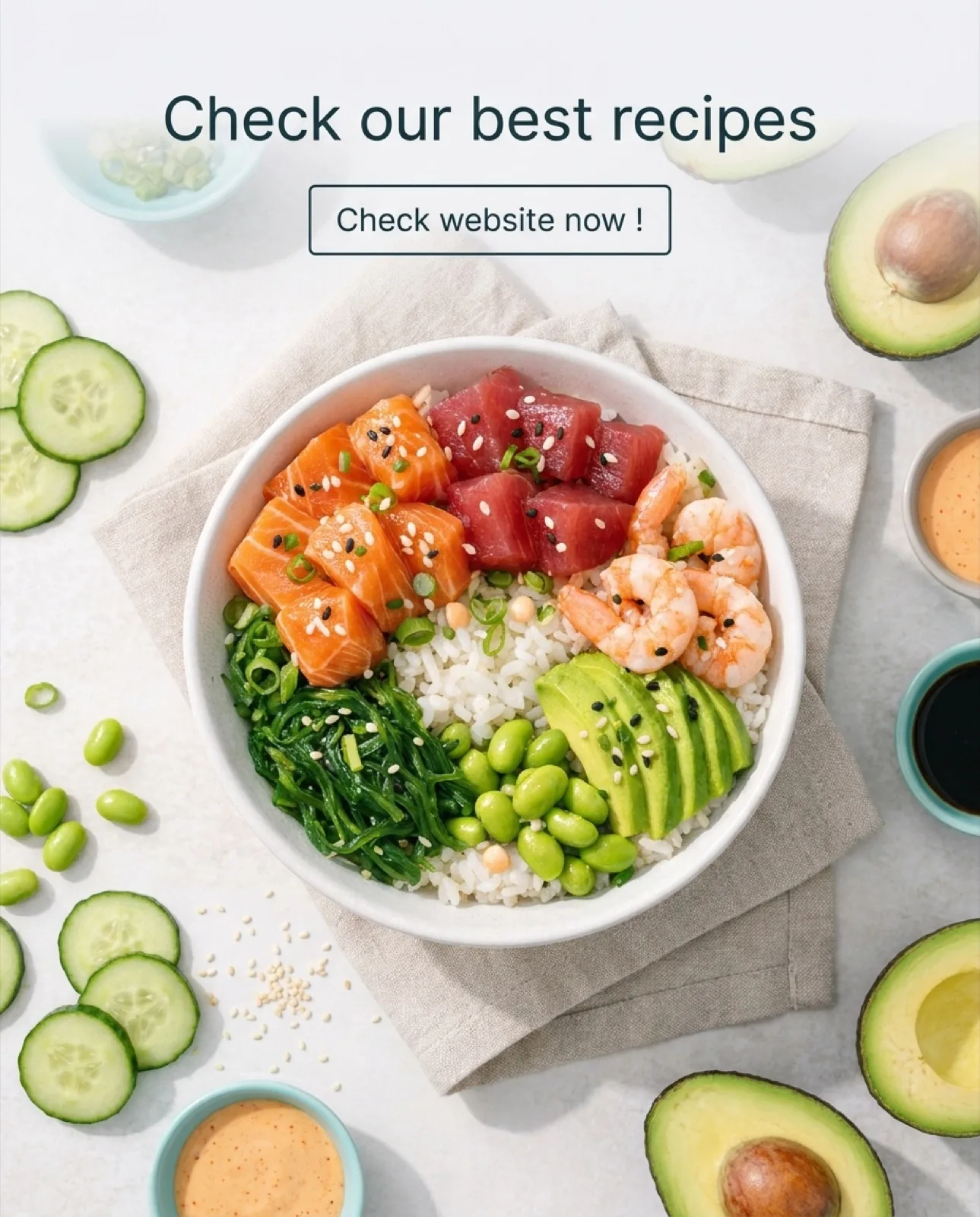
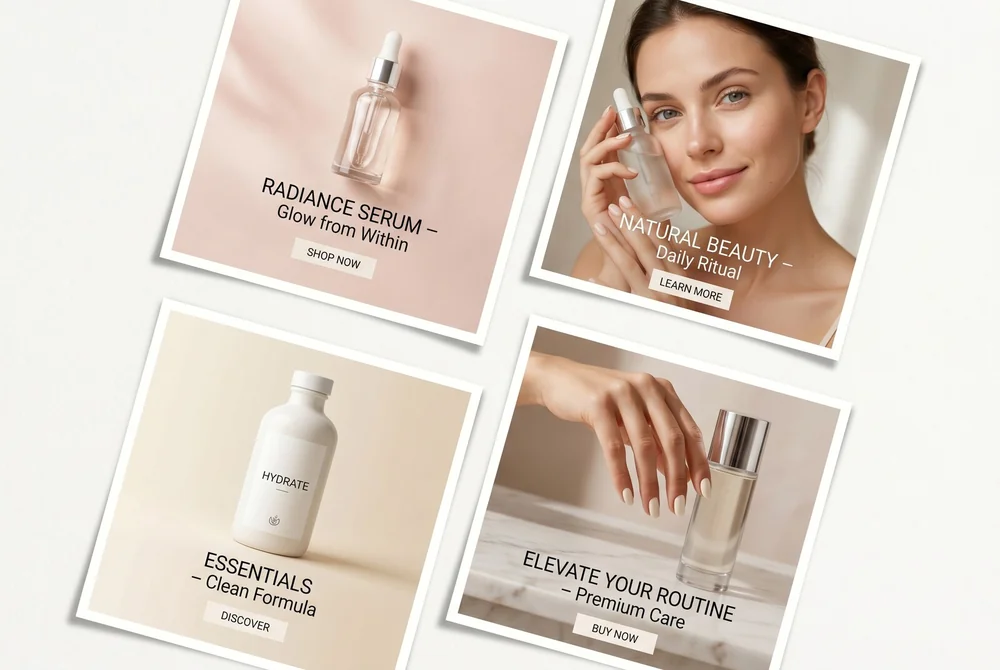
Four of the five formats above, as they actually look in a feed. The fifth (UGC-style video in 9:16) is the top performer of the list and is the one format a still image cannot show. Note how the poke bowl keeps its message under seven words and the carousel set repeats the same layout across four cards.
Create your visuals with SociaLover
Generate Meta-optimized ad images in seconds with Creative Designer: enter your product URL, pick the format and style, and get several ready-to-use variations in 1:1, 4:5 and 9:16.
Write ad copy that converts
High-performing Meta copy always follows the same structure: Hook, then problem or benefit, then proof, then CTA. The hook obeys the same rules as video hooks: one idea, a specific detail, no brand name in the first line.
Recommended structure:
Hook (line 1)
"Wasting 2 hours a day on your ad creatives?"
Stop the scroll. Ask a question, drop a number, or make a bold statement.
Body copy (2 to 4 lines)
"Most marketers still create their visuals by hand. With SociaLover, generate 10 variations in 60 seconds, no designer needed."
Amplify the problem, present the solution, add proof.
Proof / Social proof
"[Your real customer count] brands use it, rated [your actual rating] on [your review platform]."
Reduce hesitation. Only use numbers, testimonials or badges you can actually back up: Meta rejects unsubstantiated claims, and an inflated figure is the fastest way to lose a warm audience.
CTA (1 line)
"Try it free, link below"
One single action, clear and direct. Action verb + urgency when possible.
| Angle | Primary text | Headline |
|---|---|---|
| Problem hook (skincare) | Dull skin every morning? [Product] is a two-minute routine designed for skin over 35. [Real customer count] customers, rated [real rating] on [review platform]. Try it for 30 days, returns included. | A two-minute routine for skin over 35 |
| Social proof (software) | [Real customer count] teams switched to [Product] this year. The reason they give most, in their own words: "[one sentence from a real review]". See why in a 3-minute demo. | Join [real customer count] teams |
| Offer with a real deadline | [Product] ships free until [real date]. Order by [day] to receive it before [event]. [Real stock or time limit, or delete this line.] | Free shipping until [real date] |
Which model writes these best is a separate question, and we tested it: see which LLM writes the best ad copy.
Always write 3 to 5 versions of your hook. It is the single most impactful element on CTR. Use Chat Me on SociaLover to generate hooks from your product and target audience; it runs on Claude Sonnet 4.6 by default, with Gemini 2.5 Flash when you want speed.
Structure your campaign: the 3-level rule
A well-structured Meta campaign follows a 3-level hierarchy:
The three Meta levels and what each one controls. Decide the structure before you launch: a significant edit during the learning phase (around 50 conversions in 7 days per ad set, per the Meta Business Help Center) resets the algorithm's counter to zero.
Analyze, test, and scale
A Facebook ad is never truly "done." Continuous optimization is the key to long-term profitability. The thresholds below are ranges we observe on the accounts we run, orders of magnitude rather than universal benchmarks. Your real reference is your own account history and your margin.
When to scale?
- ROAS stable for 3 to 5 consecutive days
- CPA below your profitability threshold
- Budget not capped by audience size
- Frequency under 2 on the main audience
- At least 50 recorded conversions
The recommended scaling method: raise your budget by 20 to 30% max every 48 to 72 hours so you don't drop out of the learning phase. Abruptly doubling the budget often sends the campaign back into learning.
2026 benchmarks: CTR, CPM and CPC on Meta
The average Meta CPM in 2026 is about $13.48 according to Adamigo, inside a spread of $2.82 to $42.17 depending on the industry, so a benchmark that ignores your vertical is not a benchmark. For CTR and CPC there is no public figure we would cite; the thresholds we use are our own, from the accounts we run.
| Metric | Reported figure (2026) | What we observe on our accounts |
|---|---|---|
| CPM | $13.48 average, $2.82 to $42.17 by industry (Adamigo) | Watch the trend, not the level; a rising CPM on a stable audience usually means creative fatigue |
| CTR | No single public figure we would cite | Above 1.5% on an image ad and above 2% on video as a starting point |
| CPC | Not reported in the sources we cite | Under $0.80 for a standard e-commerce offer |
| ROAS | About 3.3x average across 11 industries (AdRiseLab); median about 2.2x (Digital Applied) | Above 3x to break even on most offers we run; the real threshold is your margin |
How those thresholds feed a weekly testing loop, and why the creative has become the main lever, is in how creative testing lifts Meta ROAS. If you are still weighing Meta against the other two platforms, Meta vs TikTok vs YouTube puts the CPMs and the median ROAS side by side.
Advantage+ and broad targeting: when the creative does the targeting
Meta's recommended setup in 2026 is Advantage+ audiences or fully broad targeting, and in that setup the creative does most of the targeting: Meta reads what the visual shows and who engages with it in the first hours, then finds more of those people. Your interest selections become a suggestion, not a boundary.
Two situations still favor manual targeting on the accounts we run. A brand-new pixel with no purchase history gives Advantage+ nothing to learn from, so a stacked interest audience of 200,000 to 2 million people gets out of the learning phase faster. And a local business with a real geographic limit needs the radius enforced, not suggested. In every other case, test both in separate campaigns for two weeks and keep the one with the lower CPA at equal spend.
The practical consequence is the one this guide is built on: with broad targeting, the visual and the hook decide who sees the ad, so the 2 to 4 creatives per ad set are not a nice-to-have, they are the targeting. The full argument, and the weekly loop that goes with it, is in how to improve Meta ROAS with AI.
The most common mistakes to avoid
Editing the ad during the learning phase
The learning phase lasts until around 50 conversions in 7 days per ad set (Meta Business Help Center). Any significant change resets the counter to zero.
Targeting an audience that is too narrow
Below 50,000 people, the algorithm does not have enough room to optimize. Aim for 200k to 2M for interest-based targeting.
Testing only one creative
Always create at least 3 to 4 visual variations and 2 copy variations per ad set. The algorithm will identify the winner.
Not excluding buyers from acquisition campaigns
Without exclusions, you spend budget on people who have already purchased. Always add your buyer list as an exclusion.
Ignoring the ad quality score
Meta rates your ads on quality, engagement rate, and conversion rate. A low score raises your CPM. Refresh weak creatives.
Frequently asked questions
- Which campaign objective should an e-commerce store choose?
- Start with the Conversions objective and the Purchase event, even on a small budget. Meta optimizes delivery for the action you declare, so an objective set to Traffic will buy you clicks rather than buyers. Awareness only makes sense for a brand-new product or brand where reach and frequency are the point.
- Should I use Advantage+ Audience or manual targeting?
- Advantage+ Audience by default once your pixel has purchase history: Meta finds buyers from what the creative shows and who engages with it. Manual targeting still wins for a brand-new pixel with nothing to learn from, and for a local business that needs its radius enforced. When in doubt, run both in separate campaigns for two weeks and keep the lower CPA at equal spend.
- How much budget do I need to exit the learning phase?
- Enough to reach around 50 conversions in 7 days per ad set, which is how Meta defines the end of the learning phase (Meta Business Help Center). The dollar amount follows from your cost per purchase: at a $30 CPA that is roughly $1,500 a week per ad set, or about $50 a day at a $7 CPA. Our usual floor is $50 a day per ad set.
- How much should I spend to test a Facebook ad?
- On the accounts we run, $5 to $10 a day per creative for the first three days is enough to read a CTR, then cut, hold or scale. With 2 to 4 creatives per ad set that is $10 to $40 a day per ad set for a test. Treat these as orders of magnitude: a high-ticket offer with a slow purchase cycle needs longer, not more per day.
- How many creatives should I put in one ad set?
- Two to four creative variations per ad set, so the algorithm has enough material to identify a winner. Testing a single visual is one of the most common mistakes on Meta: plan at least three or four visual variations and two copy variations before you launch.
- How large should a Facebook target audience be?
- Below roughly 50,000 people the algorithm has too little room to optimize. For interest-based targeting, aim for 200k to 2M and stack two or three relevant interests. Lookalike audiences at 1 to 3%, built from your buyers or 30-day visitors, are the highest-performing option once your account has history.
- How fast can I scale a winning ad?
- Raise the budget by 20 to 30% at most every 48 to 72 hours. Doubling it abruptly usually sends the campaign back into the learning phase. Scale only once ROAS has been stable for 3 to 5 consecutive days, CPA sits below your profitability threshold, frequency is under 2 on the main audience, and you have recorded at least 50 conversions.
- Why should I avoid editing an ad just after launch?
- Until around 50 conversions in 7 days per ad set, the campaign is in the algorithm's learning phase (Meta Business Help Center). Any significant change (budget, audience, creative) resets that counter to zero and the campaign starts learning again. Decide your structure before launch and let the ad run.
- What is a good CTR for Facebook ads in 2026?
- There is no universal figure. On the accounts we run, above 1.5% on an image ad and above 2% on video is the point where a creative earns more budget, with a CPC under $0.80 for a standard e-commerce offer and a ROAS above 3x to break even. Those are ranges we observe, orders of magnitude; your reference is your own account history and your margin.
Recap: your pre-launch checklist
SociaLover helps you produce the creatives that matter most (static visuals, UGC-style videos, ad scripts, and AI variations) in minutes, ready to upload straight into Meta Ads Manager.