Meta Ads vs TikTok Ads vs YouTube Ads: Which Platform for Which Business in 2026?
CPM, audiences, ad formats, average ROAS: the three platforms compared side by side, with a recommendation by sector and by budget so you know where to put your first euro.
SociaLover Team · Updated · 16 min read
TikTok has the cheapest CPM in 2026 (roughly $4 to $10), Meta the most expensive (roughly $13 to $15) but the highest median ROAS (about 2.2x versus 1.4x on TikTok, according to Digital Applied), and YouTube sits in between with the widest reach for consideration. Pick by funnel stage and business type, not by CPM alone; here is how to split a first budget.
Which platform is cheapest per thousand impressions in 2026?
TikTok is the cheapest per thousand impressions in 2026, at roughly $4 to $10 according to Trendtrack, ahead of YouTube ($9.20 to $14.85 depending on the format, according to Digital Applied) and Meta ($13 to $15, with Adamigo measuring a $13.48 average). A cheap impression is not a cheap customer, though: the same sources put the median ROAS at about 2.2x on Meta against 1.4x on TikTok.
Meta Ads
Average CPM (reported, 2026)
$13-15
CPC we observe
$0.50-1.30
Audience (company-reported)
3.2 billion
Median ROAS (reported, 2026)
about 2.2x
Mature retargeting, lookalike and Advantage+ audiences, the best pixel of the three for tracking intent
The highest CPM of the three, and a Facebook audience that keeps aging
TikTok Ads
Average CPM (reported, 2026)
$4-10
CPC we observe
$0.30-0.90
Audience (company-reported)
1.5 billion
Median ROAS (reported, 2026)
about 1.4x
Organic virality, a highly engaged 18 to 34 audience, native formats that reward creator-style video
Less reliable attribution and less precise conversion targeting than Meta
YouTube Ads
Average CPM (reported, Q1 2026)
$9-15
CPC we observe
$0.40-1.10
Audience (company-reported)
2.7 billion
ROAS
Not in the sources we cite; we observe 2-3.5x
Long-form video, high-intent audiences through Google Search signals, brand building
Higher video production costs and a high skip rate on in-stream
CPM and ROAS figures are third-party numbers reported in 2026 (Adamigo, Trendtrack, Digital Applied) and vary widely by vertical, country and season. CPC figures are ranges we observe on the accounts we run, orders of magnitude for arbitrating a budget rather than a forecast for your account.
That spread is also why the platform question is a creative question before it is a media question. On Meta in particular, the creative decides delivery: the algorithm reads what the visual shows and who engages with it, so the account with the better creatives buys the cheaper impression inside the same auction.
Which platform targets best?
Meta targets best for behavioral and retargeting use cases, YouTube for purchase intent read from Google Search, and TikTok for content affinity. In 2026 all three push advertisers toward broad targeting and automated audiences, so the settings matter less than they did and the creative carries more of the targeting.
| Criterion | Meta | TikTok | YouTube |
|---|---|---|---|
| Demographic targeting | ★★★★★ | ★★★★ | ★★★★ |
| Behavioral targeting | ★★★★★ | ★★★ | ★★★★ |
| Website retargeting | ★★★★★ | ★★★★ | ★★★★ |
| Lookalike audiences | ★★★★★ | ★★★ | ★★★ |
| Intent-based targeting | ★★★ | ★★ | ★★★★★ |
| Content-based targeting | ★★★ | ★★★★ | ★★★★★ |
Editorial ratings from the accounts we run. Meta dominates behavioral targeting and retargeting. YouTube excels at purchase intent through Google Search signals. TikTok reads content affinity better than either.
What changed since 2025
The biggest change since 2025 is that all three platforms now recommend handing the audience to the algorithm and competing on the creative instead. The details differ by platform.
Meta pushes Advantage+ campaigns and broad targeting as the default setup, and detailed interest targeting keeps shrinking: fine-grained interest segments have been retired in waves, and Advantage+ audience treats your manual selection as a suggestion rather than a boundary. The practical consequence is covered in how to build a Facebook ad that converts: the creative is what you actually control.
TikTok has made the organic post the ad unit. Spark Ads boost a creator's or a brand's existing video with its social proof intact, and TikTok Shop closes the purchase without leaving the app in the markets where it operates, which shortens the path from a viral video to a sale.
YouTube sells Shorts inventory as a vertical format in its own right, and Demand Gen campaigns spread one creative across YouTube, Shorts, Discover and Gmail with a single bid, which is how most of our YouTube consideration budgets now run.
Measurement is post-cookie everywhere: modeled conversions, server-side event APIs and aggregated reporting replace the deterministic pixel data of five years ago. Read your numbers as trends and orders of magnitude, and compare platforms on incremental lift rather than on last-click attribution.
Which ad formats does each platform offer?
Meta offers the widest format range (image, video, carousel, collection, Reels, lead forms), TikTok is video-only with In-Feed, TopView and Spark Ads, and YouTube splits between skippable and non-skippable in-stream, bumpers, Shorts and the Masthead. The formats that carry each platform are listed below.
Meta Ads
TikTok Ads
YouTube Ads
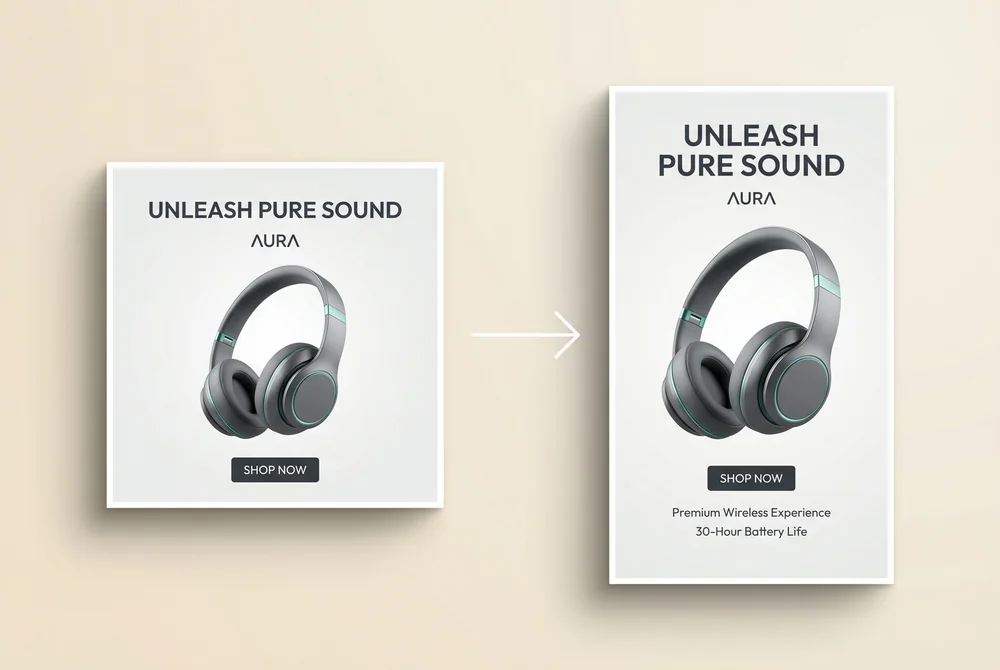
Before they are three ad products, these formats are three aspect ratios: 1:1 and 4:5 for the Meta feed, 9:16 for Reels, TikTok and Shorts, 16:9 for YouTube in-stream. Running one campaign across the three platforms means re-framing every creative three times, a production cost most budget plans forget, and the reason a cheap CPM is not automatically a cheap campaign.
Two shortcuts take most of that cost out. For vertical video, produce TikTok and Reels ads with AI from a script and a product image rather than a shoot. For the re-framing, one creative, every platform format is what Creative Resizer does: it re-cuts an approved creative into 1:1, 4:5, 9:16 and 16:9 with the composition adjusted, not just cropped.
Creative requirements per platform
Each platform rewards a different kind of creative: Meta a fast hook in 4:5 or 9:16 with statics still in the mix, TikTok a creator-shot vertical video with sound on, YouTube a brand-quality message delivered before the 5-second skip. Since August 2026 all three also require you to label AI-generated media.
| Platform | Aspect ratios | Durations that work | Style that carries it | AI label |
|---|---|---|---|---|
| Meta Ads | 4:5 feed, 9:16 Reels and Stories, 1:1 still works | 6 to 15 s on Reels, up to 30 s in feed; static images still convert | UGC-style and product demo, hook in the first 2 seconds | "AI info" label on AI-generated or AI-edited media |
| TikTok Ads | 9:16 only, with safe zones for the interface | 9 to 15 s In-Feed; Spark Ads reuse organic posts | Native, creator-shot look, text on screen, sound on | AIGC label required on AI-generated content |
| YouTube Ads | 16:9 in-stream, 9:16 Shorts, 6 s bumper | 6 s bumper, 15 s non-skippable, 15 to 30 s skippable | Brand-quality video, message before the 5-second skip | Altered or synthetic content disclosure on realistic AI video |
The formats that win are documented platform by platform: the creative types that work on Meta rank UGC-style video, product demos and before/after first, while the UGC formats that carry TikTok are creator-shot testimonials, unboxings and day-in-the-life clips. AI-generated people are allowed on every platform as long as the label is on; the label costs nothing in the accounts we run when the creative is honest about what it is.
Which platform for which business?
Meta wins for e-commerce, mobile apps and local businesses, TikTok for viral consumer products aimed at 18 to 34 year olds, and YouTube for B2B, education and considered purchases that need explaining. Audience size sets the ceiling; whether your buyer is inside it sets the answer.
Recommendations by sector
E-commerce / DTC (Direct to Consumer)
Dynamic catalogs, lookalike audiences, and multi-touch retargeting make Meta the most profitable platform for e-commerce at scale, and the median ROAS reported in 2026 is the highest of the three.
Viral products / Fashion / Beauty / Lifestyle
TikTok's viral mechanics reach a young audience with native UGC formats, and TikTok Shop shortens the path to purchase where it is available.
B2B / SaaS / Professional services
YouTube lets you target high-intent audiences through Google keywords. Long-form formats give you room to explain complex offers.
Mobile apps
Meta's mobile attribution through SKAdNetwork and app event optimization remains the most complete of the three.
Education / Info products
Audiences watching educational content on YouTube are in a learning mindset. Long-form formats help qualify the lead.
Restaurants / Local businesses
Precise geographic targeting and Lead Ads formats let you capture local prospects at low cost.
Gaming / Entertainment
TikTok's gaming audience is highly engaged. Branded Hashtag Challenges drive organic engagement that is hard to reach on other platforms.
Automotive / Real estate / Luxury
Long-form video formats let you tell a brand story. The premium CPM matches the sizable budgets in these sectors.
Whatever the sector, the Meta leg of the plan follows the same six decisions; they are laid out in order in a Facebook ad that converts.
How much budget do you need on each platform?
You need about $300 a month to learn anything on Meta, $50 a day per campaign on TikTok (the platform minimum), and $10 a day is enough to start on YouTube. The recommended ranges below are the ones we use with clients, orders of magnitude rather than rules.
Meta Ads
The learning phase ends at around 50 conversions in 7 days per ad set (Meta Business Help Center). On the accounts we run, that usually means about $50 a day per ad set.
TikTok Ads
TikTok enforces a minimum of $50 per day per campaign and $20 per ad group. Best suited to brands that already have video content, or that produce it with AI.
YouTube Ads
Skippable formats keep costs under control: you pay only when the viewer watches 30 seconds (or the whole ad if shorter) or interacts with it.
What $1,000 buys on each platform
At the CPMs reported in 2026, $1,000 buys roughly 100,000 to 250,000 impressions on TikTok, 67,000 to 109,000 on YouTube depending on the format, and 67,000 to 77,000 on Meta. The arithmetic is indicative: it divides $1,000 by the reported CPM, and your own CPM will move with the vertical, the country, the season and the quality of the creative.
| Platform | CPM used | Impressions for $1,000 | What that budget is good for |
|---|---|---|---|
| TikTok Ads | $4 to $10 (Trendtrack, 2026) | about 100,000 to 250,000 | Reach and video views at the top of the funnel |
| YouTube Ads | $9.20 bumper to $14.85 non-skippable (Digital Applied, Q1 2026) | about 67,000 to 109,000 | Consideration: a message delivered before the skip |
| Meta Ads | $13 to $15 (Adamigo, 2026) | about 67,000 to 77,000 | Conversion and retargeting, where the median ROAS reported is the highest |
Read the last column before the middle one. TikTok's 250,000 impressions are worth having at the top of a funnel; Meta's 67,000 are the ones most likely to end in a purchase, which is why the median ROAS reported by Digital Applied is 2.2x on Meta against 1.4x on TikTok despite a CPM two to three times higher.
Should you run one platform or a funnel across all three?
Run a funnel across all three once you have more than about $3,000 a month to spend; below that, start on the single platform your business type points to and add the others as the account matures. The question is not "Meta or TikTok?" but "which stage does each one carry?"
Awareness (top of funnel)
TikTok Ads + YouTube Ads
TikTok to reach a young, engaged audience; YouTube for more polished brand content. Goal: reach and video views.
Consideration (middle of funnel)
Meta Ads (traffic + engagement)
Retarget your TikTok and YouTube viewers on Meta with product visuals. The Meta pixel is the best at tracking intent.
Conversion (bottom of funnel)
Meta Ads (catalog + conversion)
Meta's Dynamic Product Ads and abandoned-cart retargeting are the best at closing the sale.
Retention (post-purchase)
Meta Ads (custom audiences)
Upsell and cross-sell to existing buyers through custom audiences built from past purchases.
A first split we use with clients who can fund all three: about 60% on Meta for conversion and retargeting, 25% on TikTok for reach and UGC-style video, 15% on YouTube for consideration. After 30 days, move budget toward whichever stage the account is starving, not toward the platform with the lowest CPM.
| Platform | Audience | Average CPM (reported) | Format that carries it | Sector that wins there |
|---|---|---|---|---|
| Meta Ads | 3.2 billion | $13-15 | Collection and dynamic catalog | E-commerce and DTC |
| TikTok Ads | 1.5 billion | $4-10 | In-Feed and Spark Ads | Fashion, beauty, lifestyle |
| YouTube Ads | 2.7 billion | $9-15 by format | Skippable in-stream and Shorts | B2B, SaaS, education |
Frequently asked questions
- Is TikTok cheaper than Facebook ads in 2026?
- Per impression, yes. TikTok CPMs run about $4 to $10 in 2026 according to Trendtrack, which measured a $4.08 average, down 28% year on year, while Meta CPMs sit around $13 to $15 according to Adamigo. Per customer, not necessarily: Digital Applied reports a median ROAS of about 2.2x on Meta against 1.4x on TikTok. Ranges vary by vertical.
- Which platform has the best ROAS in 2026?
- Meta, on the figures reported in 2026: Digital Applied puts the median Meta ROAS at about 2.2x against 1.4x on TikTok, and AdRiseLab reports an average of about 3.3x across 11 industries on Meta, from roughly 2.2x in fashion to 4.8x in pet products. YouTube ROAS is not in the sources we cite. Ranges vary widely by vertical and by margin.
- Which advertising platform has the cheapest CPM in 2026?
- TikTok Ads, at roughly $4 to $10 per thousand impressions (Trendtrack, 2026), against $9.20 to $14.85 on YouTube depending on the format (Digital Applied, Q1 2026) and $13 to $15 on Meta (Adamigo, 2026). A cheaper impression does not automatically mean a cheaper customer: TikTok attribution is less reliable and its conversion targeting less precise than Meta.
- Can I run the same video ad on Meta, TikTok and YouTube?
- The same idea, yes; the same file, rarely. The aspect ratio changes (4:5 or 9:16 on Meta, 9:16 on TikTok, 16:9 or 9:16 on YouTube), TikTok expects a creator-shot look with sound on, and YouTube needs the message before the 5-second skip. Re-cut one approved creative per placement with a resizer, and label AI-generated media on each platform.
- Meta Ads or TikTok Ads for an e-commerce brand?
- Meta Ads for a catalog business at scale: dynamic catalogs, lookalike audiences and multi-touch retargeting make it the most profitable of the three for e-commerce, and the median ROAS reported in 2026 is the highest of the three. TikTok Ads wins for viral, fashion, beauty and lifestyle products aimed at an 18 to 34 audience, where native UGC formats and TikTok Shop shorten the path to purchase.
- What budget do you need to start on each platform?
- Meta Ads starts making sense around $300 a month, with $1,000 to $3,000 recommended; the learning phase ends at around 50 conversions in 7 days per ad set, about $50 a day per ad set on our accounts. TikTok enforces a minimum of $50 a day per campaign and $20 per ad group, so plan $1,500 to $4,000 a month. YouTube is the most permissive at $10 a day.
- Which platform is best for B2B and SaaS?
- YouTube Ads. It reaches high purchase intent through Google keywords, and its long formats give you the room to explain a complex offer. The same reason it wins for education and info products, where the audience is already in a learning mindset. Meta dominates behavioral targeting and retargeting but is markedly weaker on intent-based targeting.
- Should you pick one platform or run several?
- Above about $3,000 a month, run a funnel across all three: TikTok and YouTube at the awareness stage for reach and video views, Meta at the consideration stage to retarget those viewers, then Meta again at conversion with dynamic product ads and abandoned-cart retargeting, and finally custom audiences for post-purchase upsell. Below that, start on the platform your business type points to.
- Do you need different creatives for each platform?
- Yes, on two levels. The aspect ratio changes (1:1 or 4:5 in the Meta feed, 9:16 for Reels, TikTok and Shorts, 16:9 for YouTube in-stream) so the same idea has to be re-framed at least three times. The ad products differ too: Meta offers carousels and dynamic catalogs, TikTok offers Spark Ads that boost an organic post, YouTube offers 6-second bumpers and skippable in-stream.
Conclusion
Meta Ads remains the most versatile and mature platform, essential for retargeting and e-commerce, and the one with the highest median ROAS reported in 2026. TikTok Ads is the go-to for brands targeting 18 to 34 year olds with native video content at the cheapest CPM of the three. YouTube Ads is unbeatable for brand building and products or services that need explaining.
SociaLover lets you create optimized creatives for every platform (static visuals for Meta, UGC-style videos for TikTok, scripts and storyboards for YouTube) from a single dashboard, then re-cut each one for every placement.